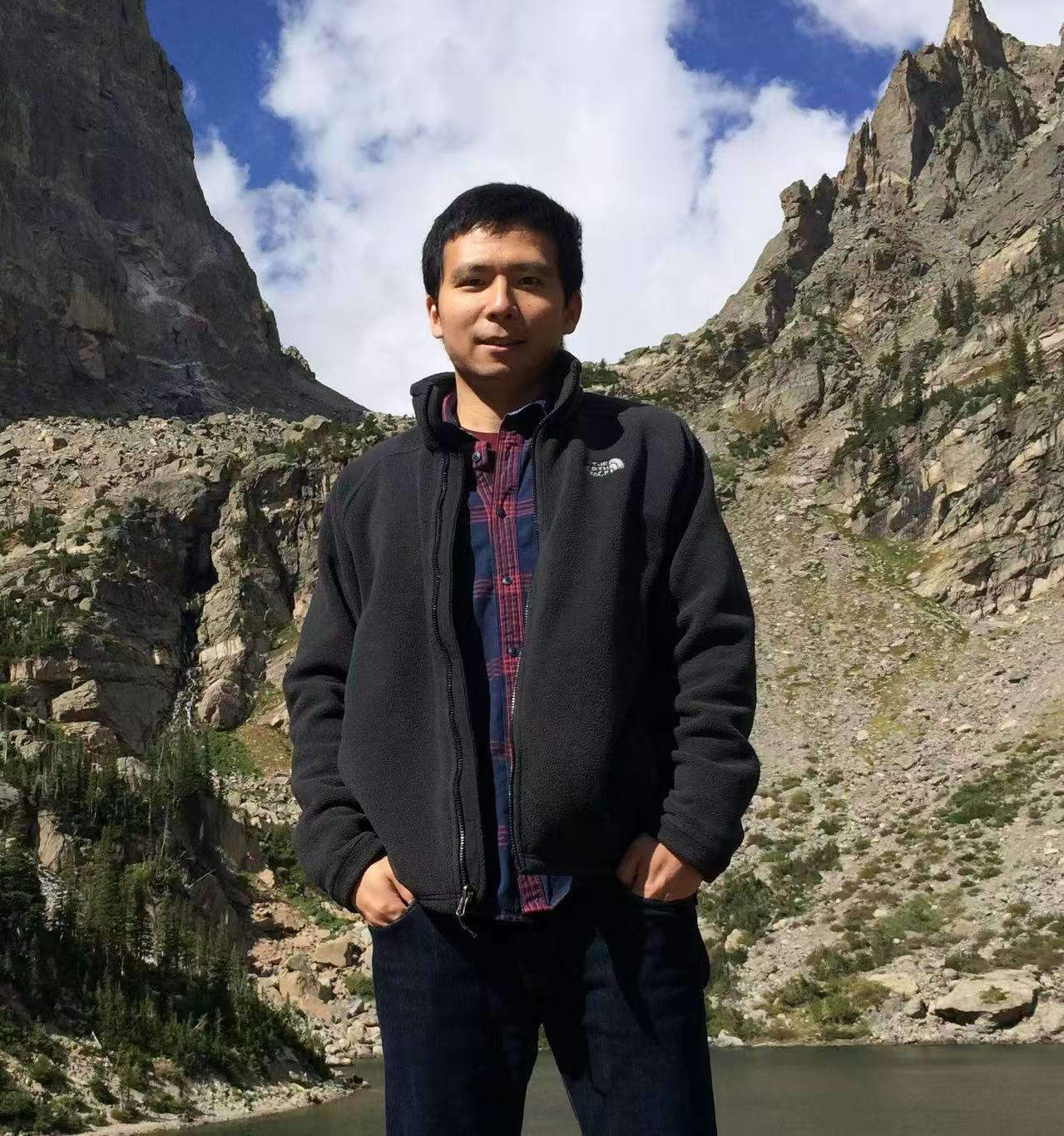
About Me
I'm an associate professor in the University Libraries and School of Information Studies and the School of Applied and Creative Computing at Purdue University. I am also a core faculty member of the Institute for Physical Artificial Intelligence (IPAI) and the Applied AI Research Center. My research asks how AI can learn the underlying structure of a specialized system from data that reveals it only partially, and how we can know when to trust what it has learned. I approach this through domain foundation models and domain world models, mostly for science, healthcare, and robotics. Before joining Purdue, I was an Assistant Professor in the Department of Computer Engineering at the Rochester Institute of Technology. I am an IEEE Senior Member and listed among the Stanford/Elsevier World's Top 2% Scientists. Over the years I've had the privilege of mentoring a group of sharp students. Sometimes they even listen to me. Outside of work, I love traveling the world and playing tennis (3.0–3.5), and I share my home with two cats, Tiger (小虎) and Meimei (妹妹), who keep the place lively.
Research Interests
My work is in Applied AI, building models that can be trusted in specialized domains across science, healthcare, and robotics. Each of these domains has its own underlying structure. General-purpose models are not trained to capture it, and the domain data that could reveal it is usually scarce, or plentiful but fragmented across labs, instruments, and protocols, and almost always expensive to collect. My research asks how a model can learn that structure from such evidence, and how we can know when to trust what it has learned. Two lines of work address this question.
Domain foundation models that adapt from limited supervision. I build foundation models for specialized domains, together with the meta-training and post-training methods behind them, including parameter-efficient fine-tuning, prompt and representation tuning, and model fusion. The aim is to learn the invariants of a domain once and carry them to new tasks and environments from a handful of examples.
Domain world models that capture how a system evolves and responds to intervention. I build world models that learn the dynamics of a specialized system, so the model can reason about consequences rather than only recognize patterns. I pair them with calibration and safety methods so their predictions hold up under distribution shift.
Both lines aim to move a model from fitting data toward understanding the system that generated it, in settings where mistakes are costly and a model has to be reliable before anyone will act on it.
Prospective Students
I take 1–2 incoming PhD students each year from Computer and Information Technology. Before a funded offer, I usually start with a 4–6 month internship alongside one of my senior PhD students, targeting a flagship conference, so we can both see whether it's a good fit. I'm demanding most of the time and occasionally short-tempered, but I'm working on it.
Services
- Area Chair, The Association for Computational Linguistics (ACL), since 2026
- Area Chair, The Conference on Computer Vision and Pattern Recognition (CVPR), since 2023
- Senior PC, The International Joint Conference on Artificial Intelligence (IJCAI), since 2023
- Senior PC, The Association for the Advancement of Artificial Intelligence (AAAI), since 2023
- Senior Associate Editor, IEEE Transactions on Circuits and Systems for Video Technology (TCSVT), since 2026
- Associate Editor, Pattern Recognition, since 2026
- Associate Editor, Neurocomputing, since 2024
Recent Publications
- Runjia Zeng, Hang Hua, Yiyang Liu, Zhiqiang Tao, Ruixiang Tang, Qifan Wang, Cheng Han, Dongfang Liu*. On the Token Value Inequality in Efficient Reasoning. NeurIPS 2026.
- Boxuan Zhang, Jianing Zhu, Zeru Shi, Dongfang Liu, Ruixiang Tang. AgentForesight: Online Auditing for Early Failure Prediction in Multi-Agent Systems. NeurIPS 2026.
- Wentao Shi, Qifan Wang, Chen Chen, Fei Liu, Dongfang Liu, Xu Liu, Wanli Ma, Junfeng Pan, Linhong Zhu, Fuli Feng. Objective Shaping with Hard Negatives: Windowed Partial AUC Optimization for RL-based LLM Recommenders. NeurIPS 2026.
- Changyu Liu, James Chenhao Liang, Wenhao Yang, Yiming Cui, Jinghao Yang, Tianyang Wang, Qifan Wang, Dongfang Liu, Cheng Han. A-SelecT: Automatic Timestep Selection for Diffusion Transformer Representation Learning. CVPR 2026. [paper]
- Shirou Jing, Chunshu Wu, Chuan Liu, Arghavan Bahadorinejad, Feitong Qiao, Dongfang Liu, Tong Geng. InfoDLM: an Information-Adaptive Framework for Discrete Diffusion Language Model Pretraining. ICML 2026. [paper]
- Feng He, Zhenting Wang, Qifan Wang, Qiang Guan, Dongfang Liu*, Ruixiang Tang, Qiankun Li. HIVE: Understanding Post-Hallucination Reasoning in Vision Language Models. ECCV 2026. [paper]
- Changyu Liu, Yiyang Liu, Taowen Wang, Qiao Zhuang, James Chenhao Liang, Wenhao Yang, Renjing Xu, Qifan Wang, Dongfang Liu*, Cheng Han. On-the-Fly VLA Adaptation via Test-Time Reinforcement Learning. ACL 2026. [paper]
- Tingxu Han, Wei Song, Ziqi Ding, Ziming Li, Chunrong Fang, Yuekang Li, Dongfang Liu, Zhenyu Chen, Zhenting Wang. Debiasing LLMs by Masking Unfairness-Driving Attention Heads. ACL Findings 2026. [paper]
- Ruibing Song, Taowen Wang, Guangyan Sun, Chunshu Wu, Qifan Wang, Dongfang Liu, Sushant Kondguli, Yuchen Hao, Ang Li, Tong Geng. BITE: Boosting LLM Training via Sandwich-Bite Dataflow and Dynamic Subspace Auto-Alignment. MICRO 2026.
- Xiang Zhang, Varchas Gopalaswamy, Rahman Ejaz, Riccardo Betti, Dongfang Liu*. Decomposition-Guided Diffusion Language Models for Inertial Confinement Fusion Prediction. EMNLP Findings 2026.
- Runjia Zeng, Qifan Wang, Qiang Guan, Ruixiang Tang, Lifu Huang, Zhenting Wang, Xueling Zhang, Cheng Han, Dongfang Liu*. TokenSeek: Memory Efficient Fine Tuning via Instance-Aware Token Ditching. ICLR 2026.
- Yanshu Li, Jianjiang Yang, Ziteng Yang, Bozheng Li, Ligong Han, Hongyang He, Zhengtao Yao, Yingjie Victor Chen, Songlin Fei, Dongfang Liu, Ruixiang Tang. Make LVLMs Focus: Context-Aware Attention Modulation for Better Multimodal In-Context Learning. AAAI 2026. [paper]
- Pegah Ahadian, Wei Xu, Dongfang Liu, Qiang Guan. Ethics of trustworthy AI in healthcare: Challenges, principles, and practical pathways. Neurocomputing, 2026. [paper]
* denotes corresponding author.
For the full list, please refer to my Google Scholar
Thanks to our sponsors